

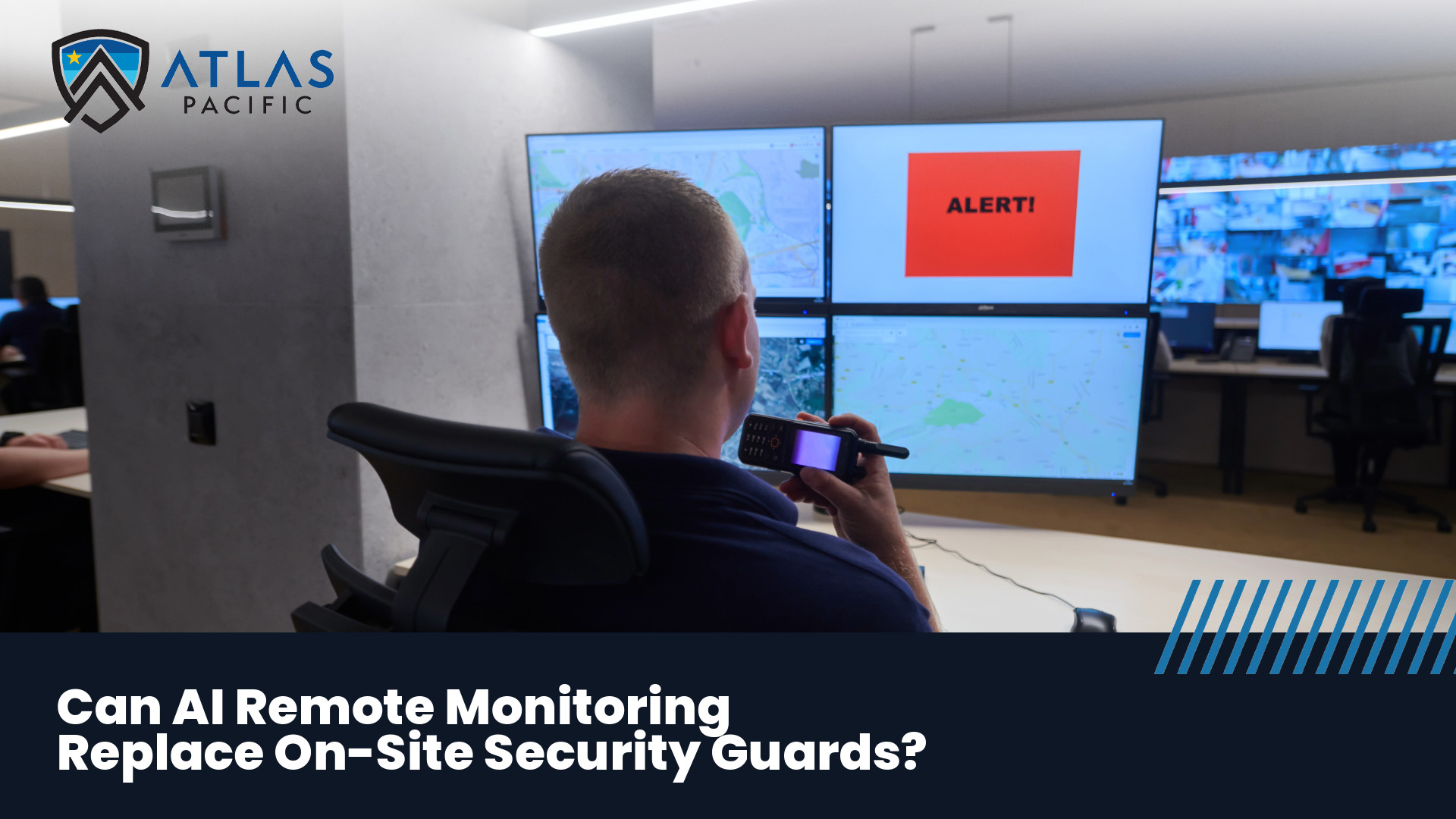
There’s no doubt that AI has changed how business owners protect their properties and assets. As these systems become increasingly intelligent, more property owners ask about AI monitoring vs security guards and whether technology can eliminate the need for an on-site security presence.
While AI offers significant advantages, a security plan is rarely a choice between technology and people. Instead, it’s figuring out the best way to combine intelligent remote monitoring with trained security professionals to create the strongest strategy.
Can AI Remote Monitoring Replace Security Guards?
AI remote monitoring can replace some routine surveillance duties, but it can’t completely replace trained security guards. AI excels at continuously watching cameras, detecting unusual activity, and alerting monitoring professionals. Security officers, however, provide judgment, physical intervention, de-escalation, access control, and an on-site presence. A hybrid security plan combines the strengths of both for more comprehensive protection.
How Does AI Remote Monitoring Work for Commercial Security?
Traditional cameras simply record footage. AI remote monitoring systems, on the other hand, analyze video feeds for activity indicating trespassing, theft, vandalism, unauthorized access, or other potential security issues.
When the system identifies suspicious activity, trained monitoring specialists review the event and determine what happens next. Depending on the circumstances, they may communicate through speakers, contact someone at the property, dispatch a security officer, or involve law enforcement.
At Atlas Pacific Security, our AIIRE platform integrates AI, professional monitoring, and a uniformed officer response. We’ve found that this cohesive approach gives businesses continuous visibility while keeping trained security professionals involved in critical response decisions.
What Are the Advantages of AI Monitoring vs Security Guards?
With AI-powered monitoring, property managers benefit from capabilities that traditional guard-only security plans can’t easily replicate. For example, AI systems can continuously watch multiple areas and help security personnel quickly identify potential problems.
AI Security Monitoring Provides Continuous Visibility
A security officer can only physically be in one place at a time. Even during regular patrols, an officer moves from one section of the property to another. AI cameras, however, can monitor multiple designated areas simultaneously. Entrances, parking areas, loading docks, equipment yards, gates, storage locations, and building perimeters can all be continuously monitored.
This coverage is especially useful across large industrial facilities, construction sites, retail properties, and multi-building commercial campuses.
AI Monitoring Can Detect Threats Quickly
AI systems continuously monitor camera feeds for predefined activity and suspicious behavior. When something unusual occurs, the AI monitoring technology flags the event before security guards can manually detect the activity. That speed means monitoring specialists can quickly investigate and start an appropriate response.
AI Remote Monitoring Can Reduce False Alarms
Traditional motion sensors respond to any movement, including harmless movement caused by animals, weather, or debris. Intelligent video analytics, however, can provide more context before generating an alert.
Human verification adds another layer of monitoring to reduce false alarms. Instead of automatically treating every movement as an emergency, monitoring professionals can assess the situation before deciding to intervene.
In our experience, pairing AI detection with human verification helps security teams focus their efforts on real threats instead of wasting time on unnecessary responses.
Remote Security Monitoring Can Improve Coverage Efficiency
Sometimes it’s not realistic to place an officer around the clock at every entrance, parking lot, building, or vulnerable area. With AI remote monitoring, however, security teams can extend their visibility without simultaneously stationing personnel everywhere.
Instead, businesses can position security guards where their physical presence provides the greatest value and let AI monitoring cover the broader property surveillance.
What Are the Limitations of AI Monitoring vs Security Guards?
The strengths of AI monitoring don’t negate the need for on-site security guards. Yes, cameras and analytics can identify potential problems, but technology can’t perform every function that a trained security professional handles.
AI Can’t Physically Respond to an Incident
A camera can detect someone entering a restricted area. A speaker can warn a trespasser to leave. But AI can’t walk across the property, investigate conditions in person, assist employees, secure a damaged entrance, direct traffic, or provide a physical presence during an evolving incident.
When a situation requires action on the property, businesses still need a trained responder.
Security Officers Bring Human Judgment
No algorithm fully understands every situation. Security incidents involve context, communication, body language, changing circumstances, and decisions that require human judgment.
Unlike AI monitoring, trained security officers can evaluate what they see and adjust their response as events unfold. They can also communicate directly with residents, employees, customers, visitors, contractors, and emergency responders.
Security Guards Provide a Visible Deterrent
A uniformed security officer or marked patrol vehicle sends an immediate message that someone is actively monitoring the property. That visible presence is often all it takes to discourage unwanted activity before it starts.
Remote cameras can also serve as a deterrent, especially when businesses use visible equipment, lights, sirens, or live audio warnings. However, properties with recurring security concerns may benefit from combining that technology with a physical security presence.
Technology Depends on Infrastructure
Remote security systems rely on cameras, communications equipment, power, connectivity, and properly configured software. Businesses need professional installation, maintenance, monitoring, and contingency planning to maintain reliable AI monitoring coverage.
When technology issues or unusual conditions limit what the cameras can see, on-site officers can still provide protection.
What Are the Advantages of Professional Security Guards?
When it comes to AI monitoring vs security guards, officers provide something technology can’t: a trained human who’s physically present at the location. Depending on the property’s security plan, officers can patrol buildings and grounds, investigate suspicious activity, respond to alarms, support access control, enforce property policies, document incidents, communicate with dispatch, and assist when situations require immediate attention.
On-site security guards also build familiarity with the properties they protect. That knowledge helps them recognize when a person, vehicle, activity, or condition is out of place.
What Are the Limitations of a Guard-Only Security Plan?
Security officers are still essential for many properties, but relying exclusively on guards can create limitations. For example, an officer can’t simultaneously watch every corner of a large property. Patrol routes leave some locations temporarily unattended while officers inspect other areas. Fatigue and competing incidents can also affect how much information one person can process at once.
Technology helps close those visibility gaps. AI monitoring can continuously observe designated camera zones while officers handle tasks that require human interaction and physical response. Instead of asking guards to stare at screens for hours, businesses can leverage AI to identify the events that deserve their attention.
Is a Hybrid Security Plan Better Than AI or Guards Alone?
In a word, yes. A hybrid security plan combines the scalability and continuous awareness of AI remote monitoring with the judgment, communication skills, deterrence, and physical capabilities of trained security officers.
The two security methods can work together for an optimal security strategy.
- Continuous surveillance: AI cameras monitor designated areas around the clock.
- Faster detection: Intelligent analytics quickly identify potentially suspicious activity.
- Human verification: Monitoring specialists evaluate alerts before escalating incidents.
- Active deterrence: Remote speakers, lights, sirens, officers, and patrol vehicles discourage unwanted activity.
- Physical response: Trained officers respond when an incident requires someone on-site.
- Better documentation: Video records and officer reports create useful information for property managers and investigations.
We recommend evaluating security options as a complete system. Our team can help you determine the appropriate balance of cameras, AI monitoring, patrols, and dedicated on-site security based on your property’s risks, operating hours, layout, assets, and history.
Where Does a Hybrid AI and Security Guard Strategy Work Best?
In our experience, a hybrid security model works especially well for properties with large areas to monitor, valuable equipment or inventory, recurring after-hours activity, multiple access points, or locations where incidents require a rapid physical response.
Construction sites are a good example. Cameras can watch equipment, materials, gates, and the perimeter throughout the night. AI can flag suspicious activity while professional monitoring specialists verify what’s happening. If the situation calls for physical intervention, the security team can dispatch an officer.
The same principle applies to industrial properties, apartment complexes, retail centers, office parks, warehouses, parking areas, and other commercial properties.
How Should Businesses Choose Between AI Monitoring vs Security Guards?
Start by identifying what your security plan actually needs to do. A property that primarily needs after-hours perimeter monitoring will implement AI differently than an apartment complex that frequently needs direct interaction with residents and visitors.
Consider the size of your property, number of access points, hours of operation, valuable assets, previous incidents, vulnerable areas, employee or resident safety concerns, and how quickly someone needs to respond when an incident occurs.
Then build your security plan around those risks instead of assuming that more guards or cameras will solve the problem.
We’ve found that implementing both AI monitoring and security guards delivers better results than choosing one over the other.
Build a Smarter Hybrid Security Plan With Atlas Pacific Security
The debate over AI remote monitoring vs security guards doesn’t end in a single winner. AI can make security teams faster, more aware, and more efficient, while trained officers provide the judgment and physical response that technology can’t.
At Atlas Pacific Security, we combine advanced AI remote monitoring with professional security services to create customized protection strategies for businesses, commercial properties, construction sites, and other facilities throughout the greater Portland and Vancouver area.
Instead of choosing between technology and people, put both to work. Contact us today for a free quote.
Frequently Asked Questions
Can AI remote monitoring completely replace security guards?
No. AI remote monitoring can handle continuous surveillance, detect suspicious activity, and alert monitoring professionals, but it can't perform every task that a trained security officer can. Security guards provide human judgment, physical response, de-escalation, access control, and a visible security presence.
What are the main advantages of AI remote monitoring?
AI remote monitoring can continuously watch multiple camera feeds, quickly identify suspicious activity, improve coverage across large properties, and help monitoring professionals focus on meaningful events. It can also support more efficient security operations by reducing the need for personnel to monitor every camera manually.
What can security guards do that AI monitoring can't?
Security guards can physically investigate incidents, communicate with employees and visitors, manage access points, de-escalate confrontations, assist during emergencies, patrol areas that cameras can't fully cover, and make judgment calls as situations change. AI can identify potential threats, but people remain essential when an incident requires direct action.
What is a hybrid security plan?
A hybrid security plan combines AI remote monitoring with trained security professionals. Cameras and intelligent analytics provide continuous surveillance and early detection, while monitoring specialists verify events and security officers respond when a situation requires an on-site presence. This layered approach combines technological efficiency with human judgment and physical response.
Is AI remote monitoring more cost-effective than hiring security guards?
AI remote monitoring can help businesses extend security coverage without placing an officer at every location around the clock. However, cost shouldn't determine the entire security strategy. Properties that face higher risks or require frequent physical intervention may still need security officers. A customized hybrid plan can help balance coverage, response needs, and budget.
What types of properties benefit from hybrid security services?
Hybrid security works well for construction sites, warehouses, industrial facilities, apartment communities, office parks, retail properties, parking areas, equipment yards, and other commercial locations. Properties with large areas, multiple access points, valuable assets, recurring after-hours activity, or a need for physical response may benefit most from combining AI monitoring with professional security personnel.
How does Atlas Pacific Security combine AI monitoring with security officers?
Atlas Pacific Security combines AI-powered remote monitoring, human verification, and professional security response through its layered security services. AI helps identify potential threats, trained monitoring professionals evaluate events, and uniformed officers can respond when an incident requires someone on site.

