

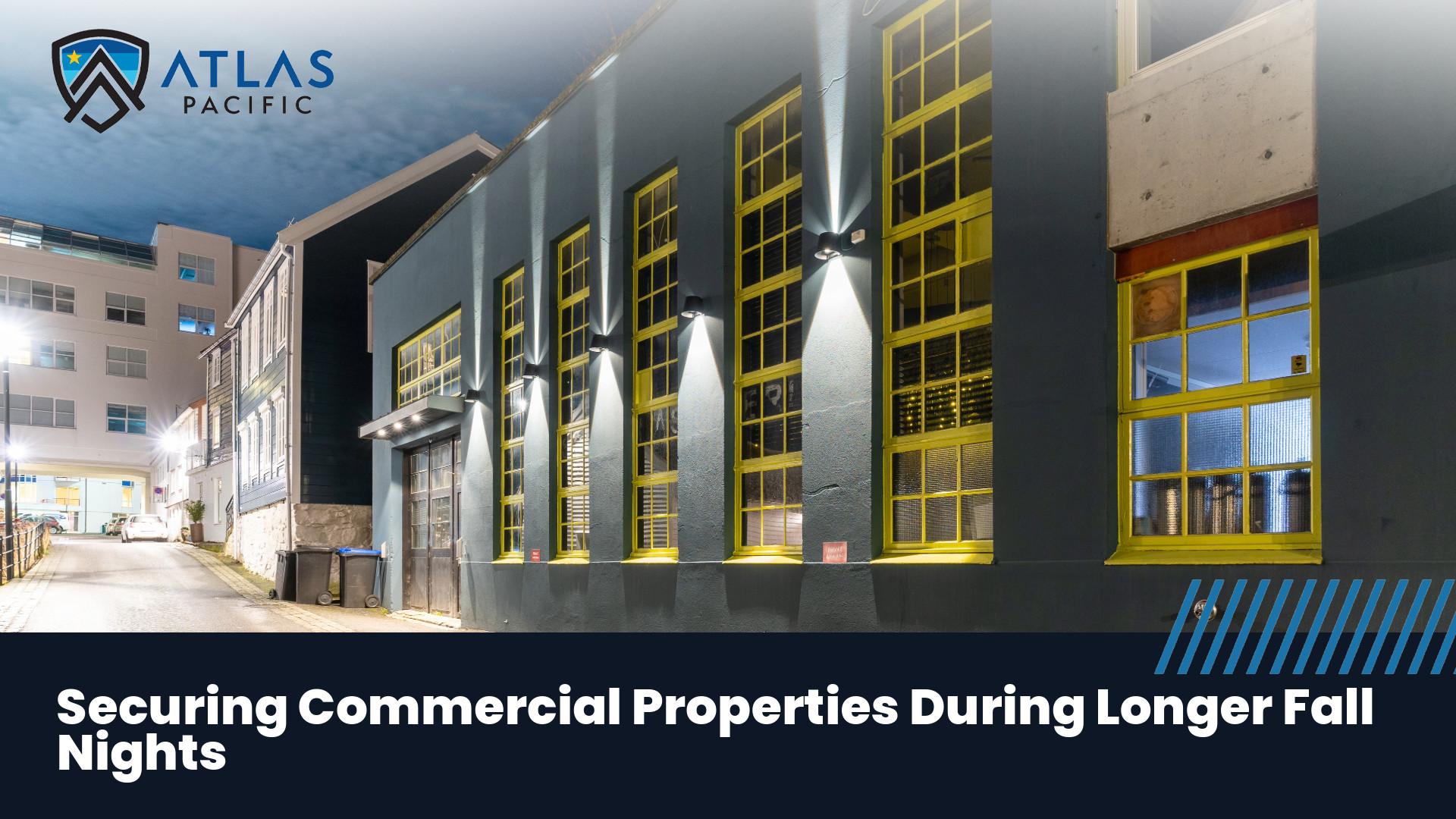
As autumn sets in, commercial property owners face a distinct shift in environmental conditions: longer hours of darkness and changing weather patterns. With sunset occurring earlier each afternoon, commercial property security monitoring becomes essential to safeguard physical assets, dark parking areas, and vulnerable perimeter access points. In our experience at Atlas Pacific Security, proactive monitoring during these extended dark periods significantly reduces trespass, vandalism, and burglary risks.
Why Is Commercial Property Security Monitoring Vital During Fall?
Commercial property security monitoring is critical during the fall because longer nights provide extended cover for unauthorized access and criminal activity. Integrated monitoring combines real-time video analytics, remote video surveillance, and immediate alarm verification to detect perimeter breaches, prevent property damage, and ensure swift security response across commercial sites before incidents escalate.
The Autumn Risk Shift: Why Darkness Increases Commercial Vulnerabilities
The transition into fall alters the security profile of every commercial facility. When darkness sets in hours before employees finish their shifts or long before morning operations resume, physical gaps in visibility expand dramatically. Shadowed walkways, poorly lit loading docks, and dark perimeter fencing become ideal targets for opportunistic crime.
During the warmer months, natural daylight acts as a passive deterrent. However, as fall nights lengthen, commercial properties experience prolonged periods of isolation. Based on client results across warehouse, retail, and corporate facilities, unmonitored properties experience a marked increase in property damage, illegal dumping, and unauthorized loitering during the late afternoon and evening hours.
To mitigate these heightened seasonal risks, property managers must understand how comprehensive commercial property security monitoring addresses specific seasonal vulnerabilities:
- Extended Exposure Windows: Unoccupied facilities remain dark for up to 14 hours per night, giving intruders ample time to identify vulnerabilities.
- Reduced On-Site Visibility: Standard security guards cannot simultaneously monitor every shadowed angle of an expansive property.
- Seasonal Weather Disruptions: Heavy autumn rain, fog, and falling foliage can obscure traditional camera lenses and distort motion detection systems if proper monitoring technology is not deployed.
Core Components of Effective Commercial Property Security Monitoring
To maintain robust perimeter defense throughout the fall and winter months, businesses like yours require a layered approach to commercial property security monitoring. Modern commercial security relies on high-definition hardware, intelligent software, and verified response protocols.
1. High-Definition Thermal and Low-Light Surveillance
Standard security cameras struggle in low-light conditions, often producing grainy images that fail to capture vital details like facial features or license plates. We have found that upgrading to infrared (IR) and thermal imaging cameras ensures crisp, actionable footage in total darkness and under adverse autumn and winter weather conditions. Thermal monitoring identifies heat signatures, allowing perimeter detection systems to spot intruders hidden behind landscape features or stacked inventory.
2. Intelligent Video Analytics and Virtual Fencing
Modern commercial property security monitoring utilizes AI-driven video analytics to establish virtual perimeters around property boundaries. Unlike legacy motion detectors that trigger false alarms due to blowing leaves or small animals, intelligent video analytics differentiate between routine environmental movement and actual human or vehicle threats. When a virtual boundary is crossed during off-hours, the system generates an instant alert for live verification.
3. Live Remote Guarding and Audio Talk-Down Deterrence
Passive recording only provides footage after a crime has taken place. Live remote guarding transforms video systems into active deterrents. When an alert triggers at our monitoring center, trained operators immediately view the live feed. If an unauthorized individual is detected, operators broadcast live audio talk-down warnings over site loudspeakers. In over 90% of cases, voice warnings prompt intruders to leave the premises immediately before committing theft or property damage.
Step-by-Step Fall Security Checklist for Commercial Properties
Our team recommends conducting a comprehensive fall-security review before peak dark hours arrive. Follow these structured steps to evaluate and fortify your commercial site:
- Conduct an Autumn Lighting and Sightline Audit: Inspect all exterior lighting fixtures, including parking lot pole lights, wall packs, and entryway fixtures. Replace burned-out bulbs with energy-efficient LED fixtures, and trim overgrown tree branches that create deep shadows or block camera angles.
- Recalibrate Motion Analytics and Camera Schedules: Adjust system timers to account for earlier daylight saving changes and earlier sunsets. Ensure video analytics schedules activate prior to dusk.
- Inspect Perimeter Fencing and Access Points: Examine perimeter gates, padlocks, and fencing for structural weaknesses. Ensure access control systems, emergency exit doors, and overhead loading doors latch securely upon closing.
- Verify Remote Alarm and Dispatch Connections: Test all panic buttons, door contact sensors, and camera connectivity to confirm seamless signal transmission to your commercial property security monitoring center.
- Establish Clear Emergency Escalation Protocols: Update site contact lists so monitoring operators know exactly who to reach—and which law enforcement agencies to dispatch—when a verified breach occurs.
Securing High-Risk Areas Across Commercial Facilities
Different areas of a commercial property present distinct security challenges as fall nights lengthen. Tailoring your commercial property security monitoring protocol to specific zones ensures complete coverage.
Parking Structures and Employee Lot Security
Earlier sunsets mean employees often walk to their vehicles in complete darkness. Well-lit parking lots equipped with visible security cameras, call boxes, and active video monitoring reduce personal safety hazards and deter vehicle break-ins. Monitoring operators can track suspicious activity near employee vehicles and alert local authorities or site security personnel in real time.
Loading Docks and Exterior Storage Yards
Distribution centers, warehouses, and retail sites frequently store high-value cargo, equipment, and pallets outdoors or in semi-enclosed loading bays. Unmonitored staging areas are prime targets for night thefts. Integrating thermal surveillance with virtual beam detectors around dock doors ensures any off-hour staging activity triggers instant operator intervention.
Building Entrances and Emergency Exits
Secondary building exits and secluded service corridors are vulnerable entry points. Intruders often attempt to force rear doors under the cover of night. Door contact sensors paired with event-driven camera feeds allow operators to visually verify whether a door has been opened accidentally or forced maliciously.
Partnering with Atlas Pacific Security for Autumn Protection
Securing commercial assets requires proactive planning, advanced surveillance technology, and dedicated professional oversight. At Atlas Pacific Security, we design customized commercial property security monitoring solutions tailored to your business's unique physical layout and operational schedules.
By pairing state-of-the-art camera technology and AI analytics with round-the-clock monitoring operators, Atlas Pacific Security ensures your property remains protected throughout the longest fall and winter nights. Contact our team today to schedule your comprehensive autumn property security assessment and protect your operations before darkness sets in.
Frequently Asked Questions
How does commercial property security monitoring prevent false alarm fines?
Commercial property security monitoring utilizes video verification before alerting emergency services. Professional operators visually inspect live camera feeds when an alarm triggers, confirming whether an intruder or other threat is present before dispatching police, thereby eliminating costly false-alarm fines.
Can existing security cameras be integrated into a remote monitoring system?
Yes, in most cases, existing high-definition IP camera systems can be integrated into a central commercial property security monitoring platform using cloud connectors or software bridge devices, maximizing your current equipment investment.
Why are autumn and fall nights riskier for commercial property security?
Autumn brings earlier sunsets, creating up to 14 hours of darkness that cover unauthorized access. Additionally, seasonal weather like fog, rain, and falling leaves can block sightlines and obscure traditional security cameras if systems are not updated and professionally monitored.

